
The Headcount Trap How Workforce Reduction Undermines AI Value
AI has the potential to create significant enterprise value, but only when organizations redesign work around the complementary strengths of people and technology. Yet many companies are reducing headcount before they have demonstrated durable AI systems, meaningful productivity gains, or measurable P&L impact. AI-created capacity is not the same as realized enterprise value, and headcount reduction is a strategic choice rather than an inevitable technology consequence. This article argues that human judgment, accountability, creativity, and institutional knowledge are not costs to eliminate. They are economic assets and operating capabilities required to create, govern, and scale AI value. Workforce reductions that remove those capabilities can produce operational failures, governance constraints, capability erosion, and costly reversal.
ARTICLES
Amanda Bailey
7/22/202611 min read
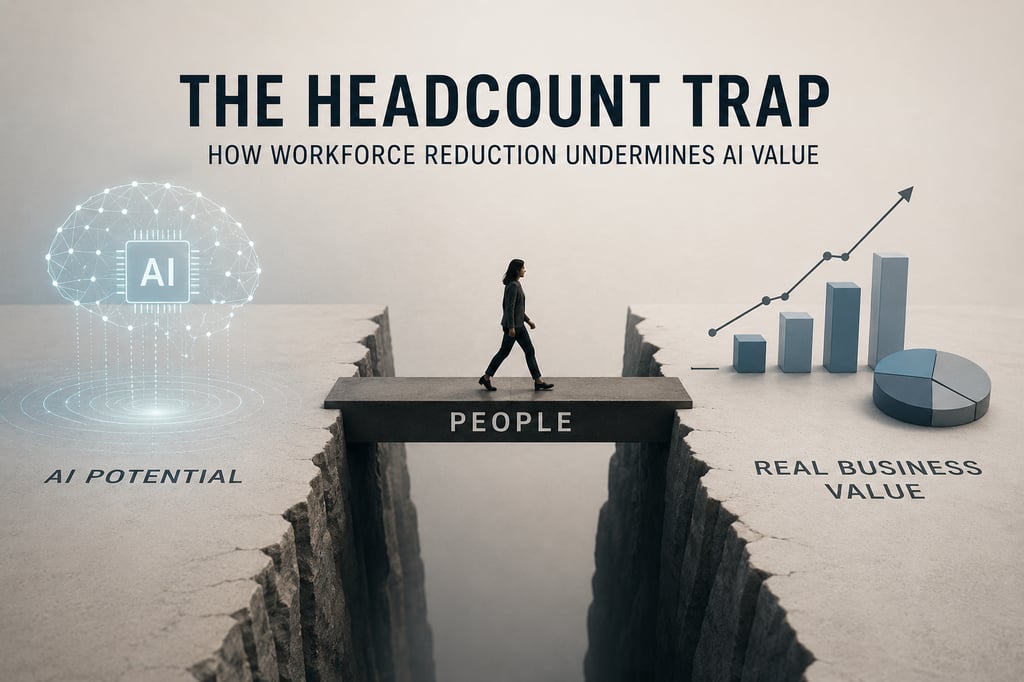
Organizations are citing AI as a reason to cut jobs before they have shipped durable AI systems or demonstrated meaningful P&L impact. Too often, AI has been treated as a labor cost-reduction lever, an easy answer to a far more difficult operating-model transformation.
This approach, as some organizations are realizing, sacrifices the human capabilities, judgment, creativity, institutional knowledge, and accountability required to turn AI into durable value. Whether the goal of AI is growth, capacity or better decisions, successful outcomes depend on execution: redesigning work and building the human-AI operating model, data foundations and governance capabilities required to scale. Cost cutting that improves operating income in the short term can weaken the very economic and operating capabilities that AI depends on.
The decision sequence should be the reverse: establish whether AI has created durable value, measure net capacity across the full workflow, decide how to allocate it, account for the human capabilities at risk, and design the operating model and governance required to scale.
Layoffs are Accelerating before AI Value has been Proven
Challenger, Gray & Christmas reported that AI was cited in 101,743 announced U.S. job cuts through June 2026, representing 23% of all announced cuts during the period and nearly twice the number attributed to AI in 2025. However, attribution is not proof that AI is doing the work or has produced measurable productivity gains to justify the cuts.1 AI adoption has not produced meaningful P&L impact across most enterprises and AI productivity data doesn’t support a strong relationship between AI adoption, usage and measured productivity gains.2 McKinsey’s State of Organizations 2026 found that 81% of organizations reported no meaningful bottom-line gains from AI, while only 19% reported AI-accelerated revenue increases above 5%.3 PwC found that only 20% of companies captured 74% of AI-driven value.4 TechCrunch surfaced UC Berkeley’s California Management Review finding that there is ‘no robust relationship between AI adoption and aggregate productivity gain’.5
Oxford Economics similarly found limited evidence that firms are replacing workers with AI at scale. Peter Cappelli, Wharton management professor, explained the gap directly: companies often say they “expect AI will cover the work” but it had not done so yet.6
This is a big distinction because organizations are making immediate and deep workforce cuts based on hype and anticipated capability rather than demonstrated operating performance. Gartner warns that AI-driven workforce reductions can create ‘short-term savings’ while increasing ‘long-term costs’ through rehiring, compensation premiums, recruitment expenses and workforce disruption.7
Oxford Economics offers a simple litmus test: if machines were replacing labor at scale, productivity should be accelerating materially, but it is not. Workforce reductions are being treated as realized savings while the underlying AI capability remains largely experimental.6 Leaders should require evidence that AI has absorbed the work, improved full-workflow productivity, and sustained quality before treating headcount reduction as realized value.
Perceived Productivity does not Equal Enterprise Value
AI productivity is often inferred from how quickly a single task is completed rather than the full workflow, but a task is not a workflow, and a workflow is not a job. Task efficiency is not evidence of enterprise productivity. A faster first draft or automated step does not prove higher end-to-end productivity unless organizations also measure review, correction, exceptions and downstream work.8
Research cited by TechCrunch identified a productivity paradox in which perceived gains exceed measured gains.5 One contributor is “workslop,” AI-generated output that looks complete but shifts the work of interpreting, correcting and finishing it to someone else.9 Each incident required recipients to spend an ‘average of one hour and 56 minutes’ dealing with the downstream work created by workslop.
Therefore, the ‘perceived’ time saved only represents potential capacity, not permanent productivity gain or enterprise value. Gartner similarly found that 19% of employees reported no time saved with AI and advised leaders to measure the depth and diversity of AI use rather than hours saved alone.10 Value is created only when that capacity produces measurable improvements in throughput, better quality, faster decisions, revenue, risk reduction, or improved customer outcomes.11 Leaders should measure the complete workflow, including review, rework, exceptions, and downstream effort, before converting estimated time savings into capacity or headcount assumptions.
Headcount Reduction is a Strategic Choice, not an Inevitable Technology Consequence
AI-created capacity does not determine its own destination. Once organizations have actually measured the net capacity created, including the review, rework and new downstream or governance work generated, leadership decides how to allocate it: accelerate, redeploy or reduce. Capacity can fund innovation, portfolio growth and revenue, or allow employees to move into higher-value work.
Headcount reduction is not an inevitable technology outcome. It is a capital-allocation choice that should follow, not precede, evidence of sustained net capacity and a clear understanding of the costs and consequences.
Stanford’s analysis of 51 enterprise AI deployments identified acceleration, redeployment and headcount reduction as potential enterprise responses to AI-created capacity, reinforcing that the outcome reflects strategic corporate choices about how value will be created.12 If reduction were the inevitable result of automation, McKinsey's workforce data would look different. Instead, one in five organizations cut roles while over half chose upskilling, reskilling or redeployment for the employees gen AI affected.3 A separate McKinsey survey found that freed up time largely went into new work rather than headcount reduction, and 38% of leaders don’t expect material workforce size changes over the next three years.13 The technology created the opportunity. Leadership decided what to do with it.
The upside case makes the strategic choice concrete. Rather than reducing headcount, organizations that reinvested AI-created capacity into faster roadmaps, new features and market repositioning captured compounding returns: each gain in speed created more room for innovation, revenue and learning. 2,12 That outcome didn't come from the technology, it came from a decision to build rather than shrink. By contrast, those that chose headcount reduction captured a one-time payroll line improvement that may mask significant, less visible costs.7,12
AI can redistribute work rather than eliminating it. As AI workflows become more agentic, work may expand across supervision, exception handling, governance, decision accountability, redesign, integration and higher-order decision making, creating new human capacity requirements even as other work is automated.5,12,14,15
The Workforce Economics of Losing Human Judgment
The institutional knowledge, context, accountability and judgment that leave with experienced team members cannot be immediately replaced by AI or agents or reconstructed by remaining employees. Observation is how humans build judgment, absorbing context, expertise and organizational norms simply by being in the room. AI lacks that channel entirely. When organizations remove the people who hold that knowledge before it has been codified or made explicit, they remove part of the operating capability their AI systems depend on.16
The risk extends beyond expertise lost through layoffs. Executives across industries are watching de-skilling unfold in real time. Half of the 70 C-suite leaders and senior executives surveyed globally by BCG said they're already observing it, and over 60% see it becoming a serious threat within the next three to five years. Additionally, the early-career pipeline is at risk when employees lose the opportunity to develop through observation, mentoring and taking on progressively harder decisions.16,17
The costs of the workforce gap become operational quickly, showing up in production failures, uncaught errors, lower quality outputs, governance breakdowns, lack of accountability, rebuilding domain expertise, slower decision-making and reasoning, lack of development pipelines, and restructuring, all of which are rarely modeled upfront. A customer-facing AI agent, for example, may be deployed without first codifying how good service reps handle pricing exceptions, frustrated long-term customers, or requests that sit just outside of documented policy. The AI agent “eventually goes off track, unaligned with the firm's goals, because no one ever wrote down how that particular decision actually gets made.”16 When the people who held that decision context are gone, the institutional knowledge behind it goes with them. Rebuilding it is not a technology problem; it is a human capital problem.
The operational failures also become economic costs. A credible AI workforce business case should account for exit packages, restructuring and orchestration, downstream rework, production failures, customer-service degradation, delayed decisions, lost knowledge and development pathways, contractor dependence, lower organizational trust, and the potential cost of rehiring and onboarding. Gartner estimates that as many as 30% of roles displaced by ‘AI’ will be rehired by 2029, frequently at higher cost.7
Klarna and Ford provide visible examples. Klarna began reinvesting in human support as quality declined.18 Ford rehired human engineers after AI failed quality checks.19
Many organizations do not actually eliminate costs with workforce reductions. They move them across time, functions and accounting categories, while weakening capabilities that are harder and more expensive to rebuild.7 Human judgment and creativity are part of the infrastructure through which AI-enabled value is created.
Human judgment and creativity include non-replaceable, non-automatable, and non-delegable capabilities because they are derived from lived experiences, observations, agency, values, imagination and consequences. These uniquely human capabilities are an economic asset. Better models do not remove the need for them as part of AI value infrastructure.14,20
Headcount reduction creates an immediate payroll-line improvement but, on the other side of the ledger, it reduces a significant economic asset, increases costly operational failures and gaps, and often comes with reversal costs.
"Human judgment is not overhead. It is an economic asset and a key part of the infrastructure that allows AI to create enterprise value."
The Human-AI Operating Model must be Deliberately Designed
To create AI value, organizations must understand and map the division of labor. Machines cover the scale work: ‘volume, pattern recognition, continuous monitoring and repeatable execution’. Humans carry the judgment work: ‘variance, trust calibration, critical thinking, conscience, observation, accountability and creativity’. A key boundary: humans can exercise judgment, read a room, recognize exceptions and context, and understand consequences beyond the data and the algorithm.14 AI agents still fall short of human-quality work in many cases. Researchers project that, ‘at the current rate of LLM improvement’, models may handle ‘most text-related tasks with 80%–95% success by 2029’, but only at a ‘minimally sufficient quality level’.5
In creative work, AI can generate concepts at scale, while art directors select, refine, and inject cultural meaning: "The creative vision remains human. The output velocity explodes." In customer service, chatbots can resolve routine tier-1 tickets, while human agents handle complex, emotional, high-value or unusual cases "with empathy and real authority." AI handles volume and routine; humans handle variance, emotions and consequences.20
Organizations need to intentionally design their human-AI operating model so people and machines each play to their strengths. Skip that step and the initiative risks failure, adding complexity without any real gain in performance. Adding automation to an unchanged workflow can increase complexity rather than improve performance. KPMG draws a great comparison with early automotive manufacturers that installed automated machinery into traditional assembly lines without redesigning the process. At first, delays and errors flowed downstream; value only emerged when the human-machine operating model was re-engineered. Technology alone doesn't get you the biggest productivity gains. Per research cited by the World Economic Forum, organizations that paired tech investment with investment in people hit productivity gains above 11%, compared with about 4% for those that left the human side out.14,21
The hardest AI-value challenges come after the technology is selected: identifying the right opportunities, designing operating models, redesigning organizations and workflows, adapting the workforce and building the data, governance and accountability required to scale. Workflow redesign had the strongest relationship with self-reported gen AI EBIT among the 25 organizational attributes McKinsey tested, yet only 21% of organizations have actually redesigned their workflows to capture it.13 The companies that are capturing real value, especially with Agentic AI, are taking measured approaches, starting with lower-risk use cases, redesigning work at the domain level, building cross-functional operating and governance capabilities, establishing accountability and data foundations, and scaling deliberately. 2,12,15 They are asking strategic questions about where AI can expand capacity, create new value and allow the organization to compete in ways that were previously impossible, rather than treating cost reduction as the primary objective.
This operational model is an economic multiplier without which organizations reduce their ability to evaluate, govern, scale and improve their AI systems.
Workforce Cuts Weaken the Governance Required to Scale AI
Governance is a production capability. Governance is not overhead and it is not just a policy. It is production infrastructure like a federated air traffic control system and without it production stalls, trust and adoption decline, and value is sacrificed. According to a McKinsey report, when CEOs personally oversee AI governance, organizations report stronger self-reported bottom-line results from gen AI.13 The Stanford playbook frames human oversight as a core AI system design variable, not a temporary safeguard to be removed once the technology is deployed. In the enterprise implementations it studied, attempts to reduce human review, sometimes as a result of rushed cost-cutting efforts, created an operational failure point, especially in consequential use cases with low or zero tolerance for error, regulatory requirements, risk management, monitoring and continuous improvement.12,15
Workforce reductions can make the ‘humans reviewing agents’ model particularly fragile. The people left in the loop may not have the necessary knowledge, experience or bandwidth to recognize when an output is plausible but wrong, identify an exception or understand the downstream consequences. The assumption that oversight becomes unnecessary because AI is “doing the work” can create the control gap: organizations increase AI autonomy while concentrating greater review and accountability responsibilities among fewer people.5,12,14
Governance is losing ground to deployment speed. In a Dataiku and Harris Poll survey of 600 CIOs, 82% said employees were building AI agents and applications faster than IT could keep up with, and only a quarter had full real-time visibility into the agents already running. The consequences show up downstream: 85% said explainability or traceability gaps had already delayed or blocked AI projects from reaching production, and nearly a third had been pressed six or more times in the past year to justify outcomes they couldn't fully explain.22
Governance is not a policy document; it is work performed by people. Organizations need people at each governance and accountability layer: outcome ownership, decision traceability, decision authority and runtime control. Those people need domain expertise, context, authority to intervene and bandwidth to do so. Reducing workforce capacity across business domains can become an economic constraint on an organization’s ability to govern, scale, and improve AI.12,14,23 A policy document cannot compensate for the capabilities, knowledge and bandwidth that no longer exist.
Executive Takeaways
AI-created capacity is not the same as realized enterprise value.
Workforce reduction is a strategic choice, not an inevitable outcome of AI.
Human judgment, accountability and institutional knowledge are economic assets required to govern and scale AI.
Sustainable AI value comes from redesigning work, not simply reducing payroll.
Strategic Reframe
AI creates potential business value through human-machine operating model redesign and human execution.2 AI does not replace human judgment, context or accountability required to govern consequential outcomes.12,14 Successful AI systems depend on redesigning workflows and the operating model, building adoption, and preserving the human capabilities needed to govern outcomes and convert available capacity into measurable business value.2,12,14
Current evidence does not support a simple equation in which greater AI adoption produces clean productivity gains that translate directly into clean headcount reductions.5 Measured gains remain uneven, governance gaps are slowing production deployment, and the loss of those human capabilities creates operating and economic costs.12,16,23 Some displaced capabilities may need to be rebuilt at a premium.7
Before any AI-related workforce decision, leaders should be able to answer seven questions, not assume them
What work actually disappears?
What remains or gets redistributed?
How the released capacity creates measurable value?
Where human decision authority still sits?
Who owns the outcomes?
How future expertise gets developed?
What reversing the decision would cost?
Human judgment is not overhead. It is an economic asset and a key part of the infrastructure that allows AI to create enterprise value. AI transformation that lowers payroll while weakening judgment, creativity, accountability, or organizational learning reduces the productive capital available to make AI succeed.
Originally published at Bailey Applied Intelligence.
Amanda Bailey is an enterprise data, analytics & AI executive, advisor and speaker who focuses on building trusted, AI-enabled operating capabilities to improve decision-making, leadership confidence, & support transformation & growth.
References for the article
Challenger, Gray & Christmas, Inc. “Challenger Report: June Layoffs Cool to 45,849, Down 53% From May; AI Leads Reasons for Fourth Consecutive Month.” June 2026.
QuantumBlack, AI by McKinsey. “The Symbiotic Enterprise: How cognitive and physical AI are reinventing enterprise execution.” June 2026.
McKinsey and Company. “The State of Organizations 2026.” February 2026.
TechCrunch. “Tech CEOs Are Apparently Suffering from AI Psychosis.” May 27, 2026.
Fortune. “AI layoffs are looking more and more like corporate friction that’s masking a darker reality, Oxford Economics suggests.” January 7, 2026.
Gartner. “AI Isn’t Reducing Workforce Costs: It’s Reshaping Them.” June 1, 2026.
Harvard Business Review. “Companies Are Laying Off Workers Because of AI’s Potential - Not Its Performance.” January 29, 2026.
Harvard Business Review. “AI-Generated ‘Workslop’ is destroying productivity.” September 22, 2025.
Gartner. “Gartner Predicts by 2027, 50% of Enterprises Without a People-Centric AI Strategy Will Lose Their Top AI Talent.” Press release, May 13, 2026.
Harvard Business Review. “The Gen AI Playbook for Organizations.” November-December 2025.
Stanford Digital Economy Lab. “Stanford Enterprise AI Playbook.” April 2026.
McKinsey. “The State of AI: How Organizations Are Rewiring to Capture Value.” March 12, 2025.
World Economic Forum. “Human-Machine Collaboration in Industrial Operations.” June 2026.
Pradeep Sanyal. “CAIO Emerging Because AI Has Become an Operating Problem.” June 16, 2026.
Harvard Business Review. “Teach Your AI How You Make Decisions.” June 26, 2026.
Boston Consulting Group. “When Everyone Uses AI, Companies Risk Losing Critical Skills.” June 17, 2026.
Capitol Technology University Blog. “AI and Job Replacement: A New Study Finds Surprising Correlations.” May 21, 2026.
BBC. “Ford rehires human engineers after AI fails to match quality checks.” June 29, 2026.
Power Bros Solutions. “The Human in the Loop: Why AI Augments, Not Replaces.” January 27, 2026.
KPMG. “AI Adoption to Advantage.” June 2026.
Dataiku / Harris Poll. “7 career-making AI decisions for CIOs in 2026.”
Dataiku. “Enterprise Vibe Coding has an AI governance problem.” May 8, 2026.
Contact
Start a conversation about AI strategy, governance, or operating model design.
I work with leadership teams that need clearer direction, stronger governance, and a practical path from AI experimentation to execution. For consulting inquiries, advisory support, or speaking requests, reach out directly.
Amanda@BaileyAppliedIntelligence.com
© 2025. All rights reserved.
www.linkedin.com/in/amandakbailey
PHONE
+1 (424) 249-9862